


 Study at CIT
  Current Students
  Industry and Community
 Stepping out of the office and onto the tools: Jonahs career transition
Published: 02 Jul 2026
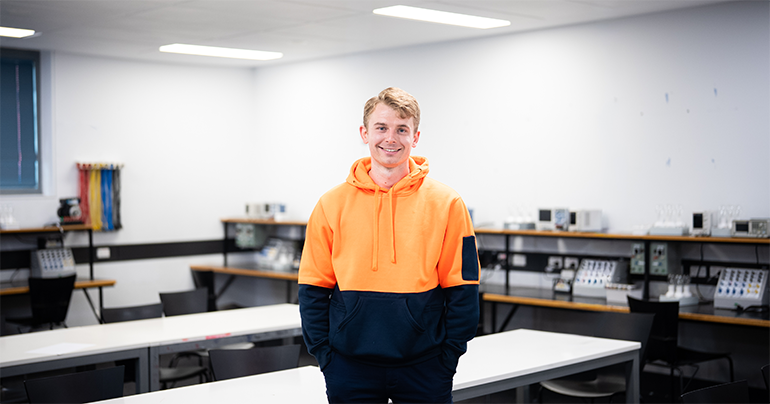
After building his career in climate adaptation and mitigation across various ACT government roles. Jonah identified an opportunity to take the next step in his professional journey. He made a strategic shift to gain hands-on experience by working in the field, moving beyond policy and into practical implementation.
With much of the big policy side of Australia’s net zero targets now established, Jonah recognised that the greatest demand lies in the on-ground workforce driving the renewable energy transition.
The Australian government forecasts a need for between 26,000 to 42,000 electricians over the next seven years1. In the ACT alone at least 1,280 additional electricians and 270 electrical engineers are needed before 2045 to meet the growing demand2.
Seeing both a skills gap and an opportunity to make a tangible impact, Jonah recognised that returning to study would allow him to progress his career while contributing directly to Australia’s net zero goals.
Fee-Free TAFE removing barriers
Ready to gain the skills needed for his career transition, Jonah applied to CIT to study electronics through Fee-Free TAFE. This opportunity allowed him to build the qualifications and knowledge required to move into his new field without the burden of upfront costs.
Fee-Free TAFE made it possible for Jonah to pursue this change without financial pressure.
“Removing that pressure made my study experience far more enjoyable,” Jonah says. “It allowed me to focus on learning rather than the added stress of costs while balancing other commitments.”
With fewer barriers in his way, Jonah has been able to fully commit to building his new career.
From theory to real-world application
One of the biggest differences Jonah noticed compared to university study was the immediate link between theory and practice.
“At CIT, you’re learning the theory and then directly applying it - seeing if it works, how it works and you are able to test and improve your knowledge and understanding straight away”, Jonah says.
This hands-on approach makes learning more engaging and meaningful, allowing students to reinforce their skills through real-world application rather than just knowing the theory behind it.
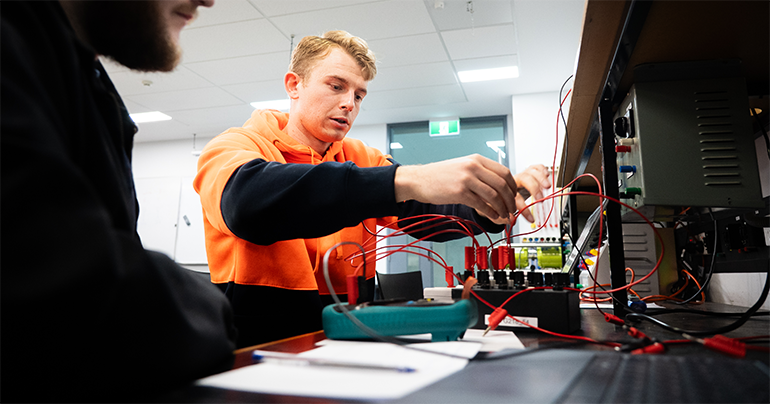
Building job-ready skills
Studying electronics is already preparing Jonah for the workforce and his goal of securing an apprenticeship in the renewable energy sector.
“This qualification is helping me build job ready skills through giving me direct experience on the kind of work that I will be doing out in the field” he explains.
From installing components to testing the voltage, current and resistance, every task connects directly to industry practice. Even the theoretical components of the course are taught in a way that immediately translates to real-world applications, ensuring learning is practical as well as relevant.
A career with purpose and demand
For Jonah choosing to study the certificate II in Electronics (UEE21920)to begin his career is about both opportunity and impact. With strong demand for electricians playing a critical role in renewable energy, the trade offers long-term career security and growth.
“Studying electronics is important for meeting Australia’s net zero targets,” he says. “it’s about contributing to solutions for climate change through renewable energy transition.”
“It’s also a rewarding trade to be in”, Jonah adds “the average pay is quite high, the conditions are good and it’s a solid career to build on”.
Advice for future students
For anyone considering studying electronics through Fee-Free TAFE Jonahs advice is to go for it.
“There are so many different support networks that are really encouraging people to get into the trade”, Jonah says. “The future is really promising, with strong demand for these skills.”
For Jonah, stepping out of the office and onto the tools isn’t just a career change, it’s a move toward a more hands-on, impactful future.
Learn more about Fee-Free TAFE and studying electronics
1. Jobs and Skills Australia, 2023, The Clean Energy Generation: Workforce needs for a net zero economy